Britain is entering a dangerous phase in which the uniform no longer automatically commands trust, because too many ordinary citizens now look at the police not as neutral guardians of order, but as unpredictable managers of political tension.
That shift in public feeling is deeply serious, because once the police lose moral authority in the eyes of the public, every stop, every warning, every arrest, and every public order intervention becomes politically charged before facts are even fully known.
For decades, policing relied not only on legal power, but on public belief that officers were trained, disciplined, restrained, and broadly fair, even when individual mistakes happened and tensions between police and communities never fully disappeared.
What is collapsing now is that broader confidence, because many people increasingly believe that officers on the street are undertrained, poorly judged, politically hesitant in some situations, and strangely overconfident in others where common sense should come first.
That is why clips of tense confrontations spread so quickly online, because they seem to confirm a growing suspicion that modern policing often looks less like calm authority and more like improvisation by people given legal powers without the judgment to use them well.
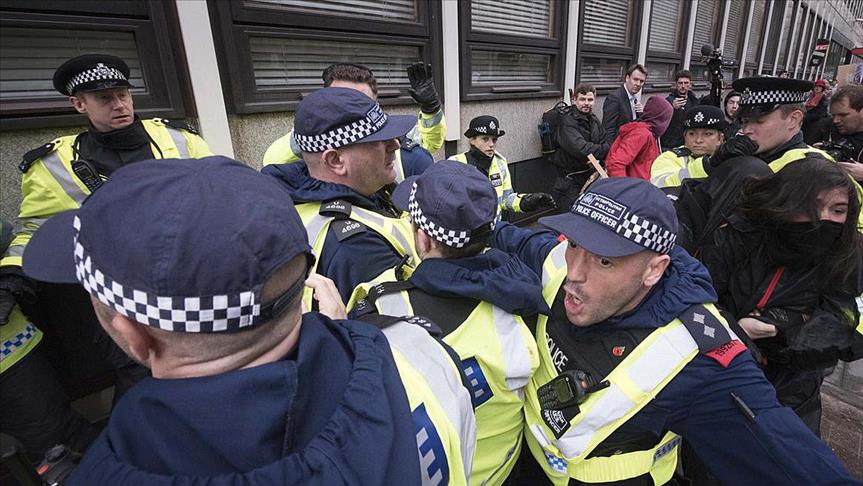
The core problem is not simply one officer saying the wrong thing, or one heated exchange in a crowded public setting, but the deeper perception that the law is no longer being applied with equal seriousness to different groups in the same environment.
Nothing poisons trust faster than the belief that the police are brave where speech is involved but hesitant where actual disorder begins, because the public will always resent a state that appears tougher on expression than on intimidation or visible aggression.
That is why debates over public order have become so volatile, because the public increasingly suspects that low-level speech, flags, slogans, or insults are policed with far more urgency than conduct that looks genuinely threatening, disruptive, or dangerous in the moment.
Whether every viral clip tells the whole story is a fair question, but politically it no longer matters as much as it once did, because perception has already become the battlefield on which public confidence in policing now rises or collapses.
When an officer appears to threaten arrest over a phrase or a gesture while more serious provocations nearby seem to draw softer treatment, people do not see nuance, context, or operational balancing; they see weakness dressed up as selective confidence.
That perception is devastating, because policing in a democracy depends on even-handedness above almost everything else, and once the public senses that one side is managed gently while another is confronted aggressively, neutrality begins to look like fiction.
This is what people mean when they speak about two-tier policing, whether or not every use of that phrase is fair in every instance, because the emotional truth behind it is that many citizens no longer believe enforcement feels equal.
The result is a corrosive cycle in which officers become defensive, citizens become confrontational, cameras come out faster, public order gets harder to maintain, and every street encounter becomes another referendum on whether the police still understand their own role.