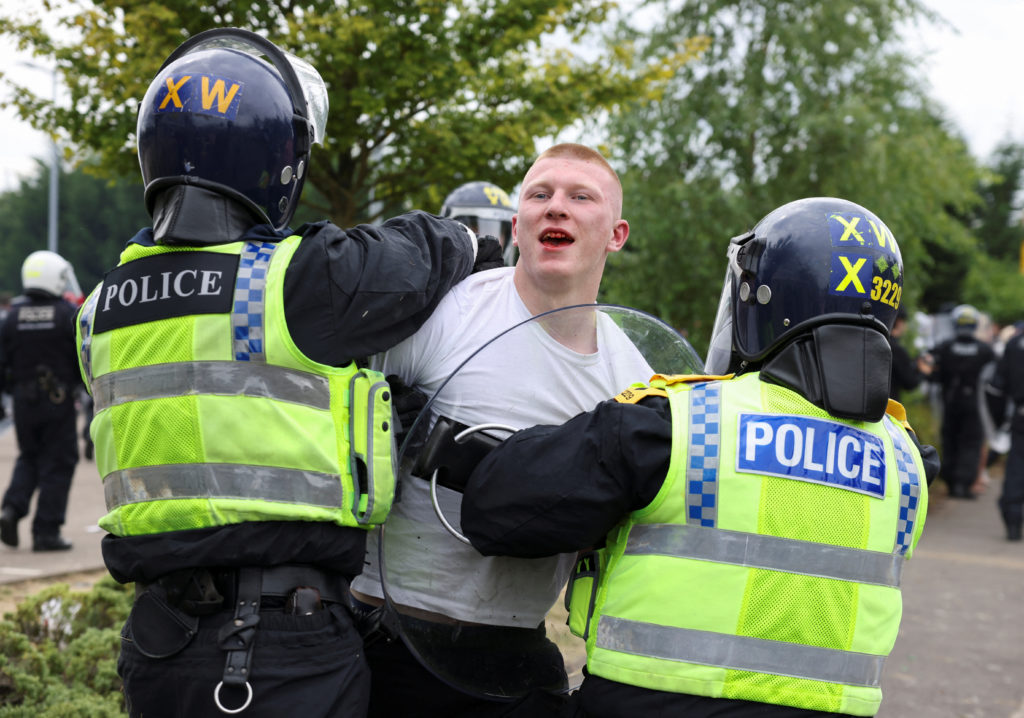
A society does not break only when violence erupts in the streets, because long before that moment arrives, it begins to fracture in language, in trust, and in the quiet belief that the system no longer treats people fairly.
That is why the most explosive political content online no longer spreads through facts alone, but through a darker combination of fear, humiliation, censorship claims, public anger, and the growing suspicion that ordinary citizens are being managed instead of heard.
Once people start believing that institutions punish speech more aggressively than disorder, the emotional contract between the public and the state begins to decay, and that decay is far more dangerous than any single headline.
Nothing drives viral outrage faster than the feeling of double standards, because once citizens suspect that one rule applies to insiders and another to everyone else, every arrest, every protest, and every official statement becomes fuel for a much larger fire.

This is the atmosphere now consuming modern politics across much of the West, where trust in leadership is collapsing, public patience is thinning, and millions are no longer asking whether institutions are flawed, but whether they remain legitimate at all.
In that climate, censorship becomes more than a policy debate, because it starts to symbolize a deeper accusation, that power is no longer trying to persuade the public, but to discipline it emotionally, digitally, and politically.
That perception alone is enough to radicalize public debate, because people will tolerate many failures from government, but they react very differently when they begin to feel that even their frustration is being monitored, criminalized, or selectively punished.
The result is a politics of permanent combustion, where every crackdown creates more resentment, every reassurance sounds scripted, and every attempt to restore order is interpreted by critics as proof that the system is hiding its own failures.
This is exactly why outrage-heavy media performs so well online, because it does not merely report institutional breakdown, it transforms that breakdown into a narrative of betrayal that feels personal, immediate, and emotionally irresistible.
Audiences do not just consume that content for information.
They consume it for recognition.
They consume it because it reflects their suspicion that something is deeply wrong, and that official language has become too polished, too evasive, and too detached to name it honestly.
The most powerful viral stories today succeed because they offer more than argument.
They offer emotional permission.
They tell viewers that their anger is not irrational, their fear is not isolated, and their distrust is not paranoia but evidence of finally seeing the truth clearly.
That is an intoxicating message in any democracy under pressure, because it turns confusion into identity and identity into movement, often before facts, context, or proportion ever get a fair hearing.
Once that process begins, politics stops functioning as a search for solutions and starts behaving like a competition over whose emotional reality feels more urgent, more authentic, and more morally charged.
A protest is no longer just a protest.
An arrest is no longer just an arrest.
A speech restriction is no longer just a legal question.
Everything becomes part of one giant story about whether the nation still belongs to its citizens or to a political class that no longer trusts them.

This is what makes public confidence so fragile right now, because when people stop believing that truth is handled fairly, they also stop believing that law is applied fairly, and once that happens, authority itself begins to look political rather than legitimate.
That loss of legitimacy is where democracies become truly vulnerable, because citizens who feel unheard may become angrier, but citizens who feel silenced begin to feel cornered, and cornered societies do not produce calm debate.
They produce escalation.
They produce conspiracy.
They produce emotional absolutism.
And they create perfect conditions for commentators who profit from keeping audiences permanently outraged and permanently suspicious.
What makes this even more combustible is that some governments respond to social anger with managerial language that sounds clinically detached from lived reality, which only deepens the impression that leaders are speaking at the public rather than with it.
When people hear rising official calm in the middle of rising public panic, they often interpret composure as denial, and denial as contempt, even when the truth may be more complicated.
That gap between institutional language and public emotion is where the most viral political narratives are born, because someone will always step in to translate confusion into certainty, often with more fury than evidence and more conviction than honesty.
These figures thrive by presenting themselves as the only ones willing to speak plainly, while casting everyone else as cowardly, corrupt, compromised, or ideologically captured by an establishment afraid of its own citizens.
That formula is powerful because it contains a kernel of truth wrapped inside a larger architecture of escalation, since institutions often do avoid difficult conversations, but outrage entrepreneurs then weaponize that avoidance into a nonstop emotional business model.
The danger is not only misinformation or manipulation.
The danger is addiction.
Audiences can become dependent on a daily stream of content that validates fear, confirms betrayal, and interprets every event as proof that collapse is accelerating faster than anyone admits.