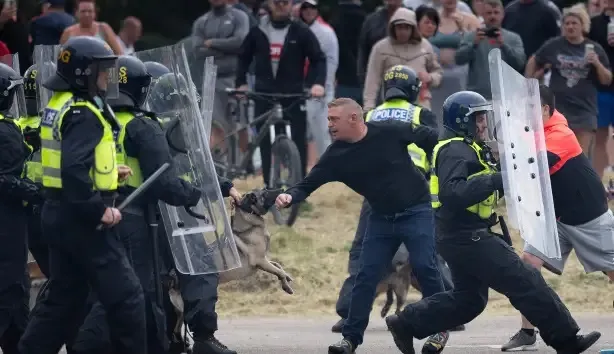
Manchester has become the latest flashpoint in a Britain that looks increasingly unable to contain its own political rage.
What unfolded in the city was not just another protest, but a dramatic display of how quickly public anger can spill into confrontation, fear, and visible disorder.
On a tense Saturday marked by heavy police presence and rival demonstrations, thousands poured into central Manchester carrying flags, banners, and competing visions of what Britain is becoming.
What began as a show of strength from anti-immigration demonstrators soon turned into a city-wide struggle over public space, political legitimacy, and who now controls the streets.
The main march gathered in large numbers near the station, with protesters chanting against illegal immigration, rising disorder, and what they see as a political class unwilling to secure borders or restore public confidence.

Their signs, slogans, and marching columns projected one simple message: a large section of the country no longer believes the current system is working.
But they did not march uncontested.
Counter-protest groups mobilized rapidly, filling nearby streets with their own banners, chants, and accusations that the demonstration itself was rooted in hostility and exclusion rather than public concern.
From that moment, the city was primed for collision.
Footage from the scene shows police lines tightening, groups surging in opposing directions, and tempers flaring almost immediately as rival crowds pushed, shouted, and challenged one another across narrow urban corridors.
Witnesses described an atmosphere of raw hostility and mutual suspicion.
There were chants, shoving, flares, smoke, and frantic attempts by officers to contain movement before confrontation escalated into something even more dangerous.
As clips spread online, the argument exploded far beyond Manchester itself.
Supporters of the march called it a long-overdue national stand against drift, weak borders, and political denial.
Opponents called it inflammatory street politics designed to provoke fear and deepen division.
That divide is now central to Britain’s crisis.
Almost every major protest now becomes two events at once: the physical confrontation on the ground, and the instant digital war over what the confrontation supposedly proves about the country.
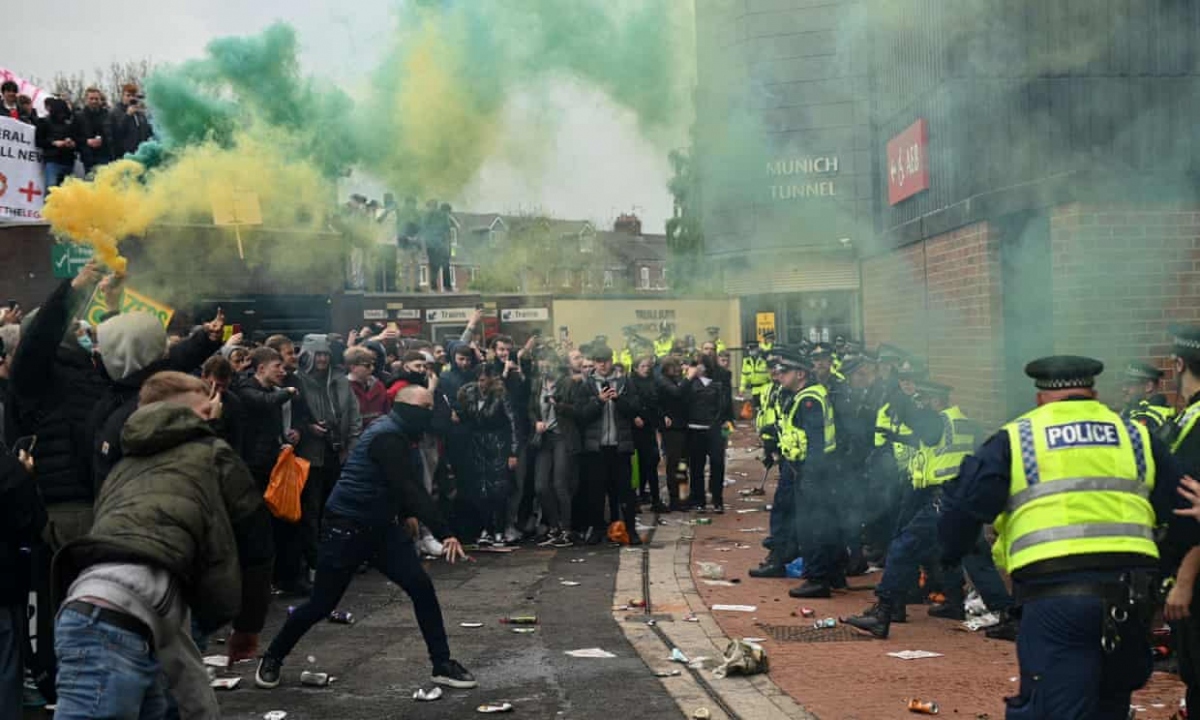 In Manchester, both battles were visible in real time.
While police attempted to hold separation lines, social media filled with videos of scuffles, crowd surges, shouting matches, and angry claims that officers were treating the two sides differently.
That perception of unequal policing is one of the most politically explosive features of modern Britain.
Whether fair in every instance or not, it now shapes public reaction instantly, because trust in police neutrality has weakened across large parts of the country.
Some protesters accused officers of shielding agitators while pushing back ordinary demonstrators more aggressively.
Counter-protesters, meanwhile, claimed they were being unfairly cast as the source of instability while far harder rhetoric was being normalized around them.
The police response became a story in its own right.
Dispersal powers were used, arrests were made, mounted units were deployed, and lines of officers were forced into repeated repositioning as pressure built on multiple fronts.
Once that happens in a major city, the symbolism becomes enormous.
It no longer looks like a contained protest.
It looks like a state struggling to preserve basic order in the face of a public mood that is increasingly tribal, combustible, and resistant to authority.
And that is why Manchester matters.
Not because one march can define the nation, but because it reflects a broader British pattern in which public grievances are no longer being processed primarily through trusted institutions, but through spectacle, confrontation, and street-level political theater.
The people marching believe they are no longer heard through ordinary channels.
That belief is what gives such demonstrations their force.
They are not only protesting policy, but declaring that the established routes of democratic response feel exhausted, delayed, or meaningless.
The people opposing them believe something equally intense.
They see these marches not as democratic renewal, but as the normalization of dangerous rhetoric wrapped in patriotism and grievance, and they believe silence would amount to surrender.
This is why the atmosphere is so unstable.
Each side believes it is defending the country from something intolerable.
Each side believes the other is being protected, excused, or misunderstood by institutions that no longer command full confidence.
.jpg)
In that kind of climate, the street becomes more than a street.
It becomes a test of resolve, a stage for identity, and a place where ideology is acted out physically rather than argued over calmly.
That is a grave warning sign for any democracy.
When politics moves too far from persuasion and too close to territorial confrontation, every public event becomes more dangerous, every camera becomes more important, and every police decision becomes more contested.
Manchester also showed how quickly national narratives now form.
Within hours, the city was being described online as either proof of a patriotic awakening or evidence of a deeply alarming turn in British street politics.
There was almost no neutral ground left.
That collapse of neutral ground may be the most serious issue of all.
Because once a country loses confidence in its institutions and loses the ability to interpret public disorder through shared facts, it becomes far easier for every incident to feed a larger spiral of grievance.
The government now faces a serious problem it cannot solve through statements alone.
If it condemns disorder without addressing the underlying anger, it will be accused of evasion.
If it addresses the anger clumsily, it risks inflaming an already divided national mood.