Britain has woken to one of the most dramatic displays of rural anger seen in a generation, as waves of tractors, trailers, and farm vehicles rolled toward London and turned the capital into a symbol of national fracture.
What unfolded was not just another protest over taxation or budgets, but a full-scale political warning from the countryside to a government many farmers now believe neither understands them nor values the role they play in keeping the country fed.
By the early morning, the effect was already impossible to miss.
Major roads into the capital slowed to a crawl, junctions filled with agricultural machinery, and whole stretches of the approach to central London became scenes of congestion, noise, and visible confrontation with the political class.

The imagery alone was enough to electrify the country.
Huge tractors in the shadow of national institutions, horns sounding across blocked roads, and angry farmers in waterproof jackets standing beside vehicles built not for spectacle, but for the daily work of feeding Britain.
That is exactly why this protest has hit such a nerve.
It is not only about a tax change.
It is about the collision between two Britains that increasingly do not trust each other and no longer believe they are even living under the same political understanding of reality.
On one side is Westminster, with its language of reform, fiscal balance, and modernized taxation.
On the other is the farming world, where families say the government has targeted inherited land, generational continuity, and the fragile economics of producing food in a country already loaded with pressure.
For the protesters, this is not a technical policy dispute.
It is personal, historical, and existential.
Many say the issue is not simply what the tax costs on paper, but what it signals about how little the state understands rural life, asset-rich farms, and succession between generations.
That is why the anger has become so intense.
Farmers do not hear “budget reform.”
They hear “forced sale,” “family breakup,” “land loss,” and a long political pattern in which those who work the countryside are expected to absorb more pain while the urban political machine keeps moving.
The convoy into London turned that resentment into a national image no minister could easily dismiss.
Once tractors enter the capital in large numbers, the argument stops being buried in Treasury papers and turns into a public confrontation between labor, land, and power.

And power is exactly what this protest is challenging.
The demonstrators are not just asking for amendments or minor concessions.
They are demanding to be treated as a foundational part of the nation rather than a politically convenient sector to tax, regulate, and lecture.
That is why the language surrounding the protest has become so heated.
Supporters call it a long-overdue stand by the people who feed the country.
Critics call it economic blackmail, deliberate disruption, and a dangerous escalation designed to force political retreat through visible paralysis.
Both sides understand the symbolism.
If the countryside can bring London grinding toward stillness, even briefly, then it reminds the public of a truth the political class often forgets: food security, land stewardship, and national resilience do not begin in policy seminars.
They begin on farms.
This is also why the protest has resonated far beyond the agricultural sector.
Many Britons who are not farmers still recognize a familiar story in it: ordinary producers feeling squeezed by distant decision-makers who appear insulated from the consequences of the policies they impose.
That wider sympathy is politically significant.
Because once a farmers’ protest stops looking sectoral and starts looking like a revolt against metropolitan detachment itself, it becomes much harder for the government to contain the narrative.
The capital, meanwhile, becomes the stage on which the clash is dramatized.
London is where policy is made, media is concentrated, and elite assumptions are projected outward.
So when rural machinery fills urban roads, it feels like an answer from the margins to the center.
That answer was unmistakable here.
The sound, scale, and visual force of the convoy turned a policy grievance into a national mood, one rooted in the belief that Britain is now governed by people who know how to talk about food prices but not about food production.
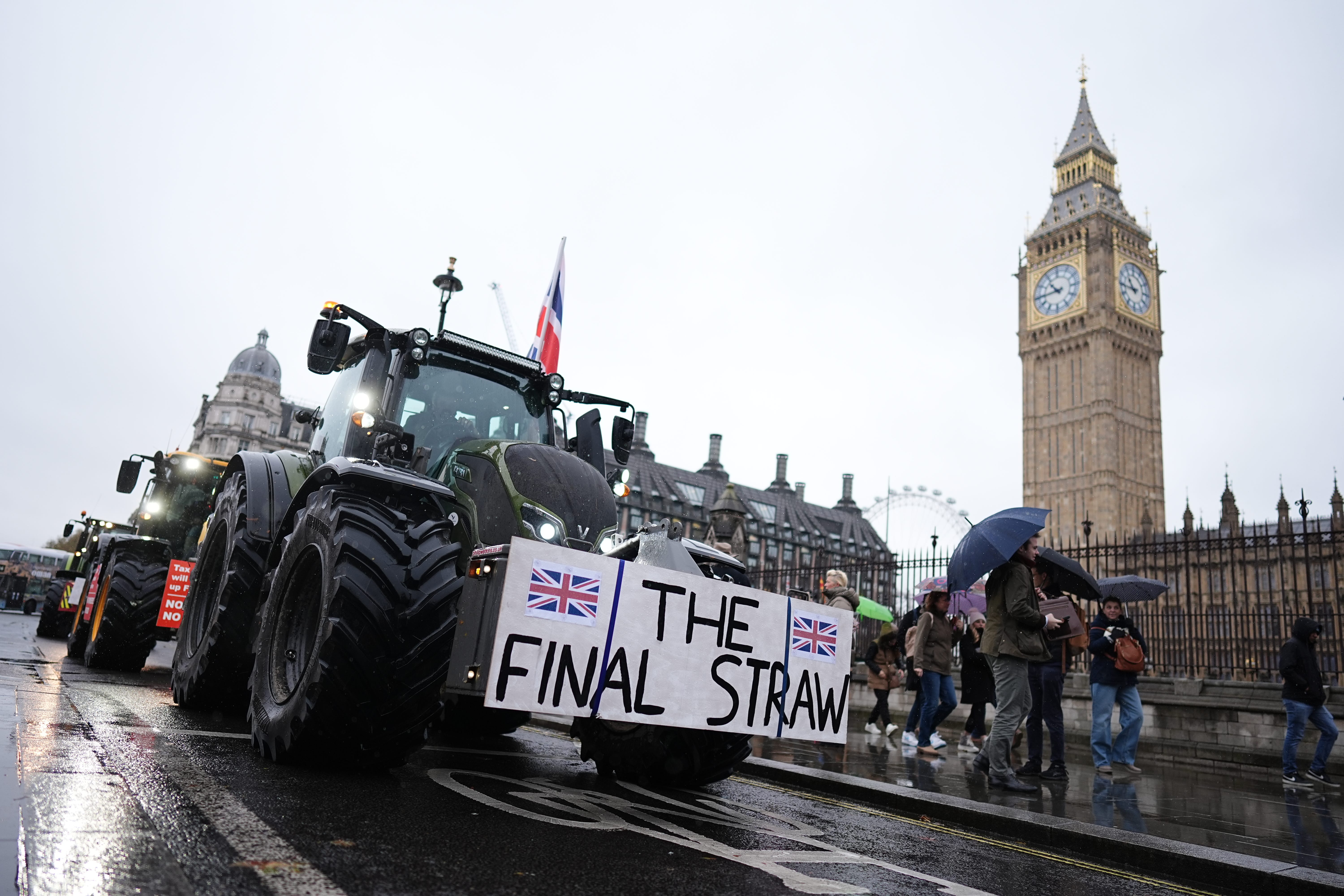
This is where the government faces its real danger.
Not simply traffic disruption, embarrassing images, or a bad news cycle, but the possibility that farmers have found a way to embody a deeper anti-establishment feeling that reaches well beyond the field gate.
Because if rural anger fuses with broader public frustration over living costs, taxation, and institutional arrogance, then this protest ceases to be a sectoral row and becomes something much harder to politically absorb.
That possibility is already visible in the language emerging around the demonstration.
The argument is no longer just that a policy is unfair, but that it reveals a ruling mentality fundamentally detached from land, work, inheritance, and the material systems that hold the country together.
Inside government, that kind of symbolism is dangerous because it weakens the image of competence.
A government can survive criticism.
It can survive protest.
But it struggles much more when large, disciplined, economically essential groups begin to look like the reasonable face of resistance.
That is exactly what ministers will fear here.
The farmers are not fringe agitators in masks.
They are not abstract campaigners.
They are visible, rooted, intergenerational, and closely tied in the public imagination to food, land, weather, and practical reality.
This gives them a moral advantage that many protest movements do not possess.
When they say they are being pushed too far, large numbers of people are inclined to believe them, because they do not look like professional demonstrators.
They look like the backbone.
